Introduction
As industrial technology continues to evolve, modern factories are increasingly relying on automation systems to achieve higher productivity, efficiency, and operational accuracy. Traditional manual control methods are no longer sufficient to meet the demands of today’s competitive manufacturing environment.
This is where industrial automation technologies such as PLC, HMI, and SCADA systems play a vital role. These systems work together to create a fully integrated control environment that allows factories to monitor processes, control equipment, and analyze operational data in real time.
By implementing these technologies, companies can improve production quality, reduce operational errors, and ensure smoother and more efficient production processes across their facilities.
The Role of PLC in Industrial Automation
A PLC (Programmable Logic Controller) is one of the most important components in industrial automation systems. It is an industrial computer designed specifically to control machines and automated processes within production environments.
The PLC receives input signals from various field devices such as sensors, switches, and measurement instruments. Based on the programmed logic, the controller processes these signals and sends output commands to control equipment such as motors, valves, conveyors, and other machinery.
Because PLCs are designed for industrial environments, they are capable of operating reliably under harsh conditions including high temperatures, dust, vibration, and electrical noise.
PLCs are widely used in automated production lines because they provide precise control over manufacturing processes and allow engineers to modify system logic easily through software programming.
Understanding HMI Systems
HMI (Human Machine Interface) systems serve as the communication bridge between operators and industrial machines. These systems allow engineers and operators to interact with automated equipment through visual interfaces.
Typically, HMI systems consist of touchscreen panels connected to PLC controllers. These screens display important operational information such as machine status, production parameters, alarms, and system diagnostics.
Through the HMI interface, operators can start or stop equipment, adjust operational parameters, monitor production performance, and respond quickly to system alerts.
One of the major advantages of HMI systems is that they simplify the interaction with complex industrial systems, allowing operators to manage processes without directly interacting with the underlying programming.
What is SCADA and Why It Matters
SCADA (Supervisory Control and Data Acquisition) systems provide a higher level of monitoring and supervisory control for industrial operations.
While PLCs control machines at the operational level, SCADA systems collect data from multiple PLCs and field devices across the factory and present it in a centralized monitoring platform.
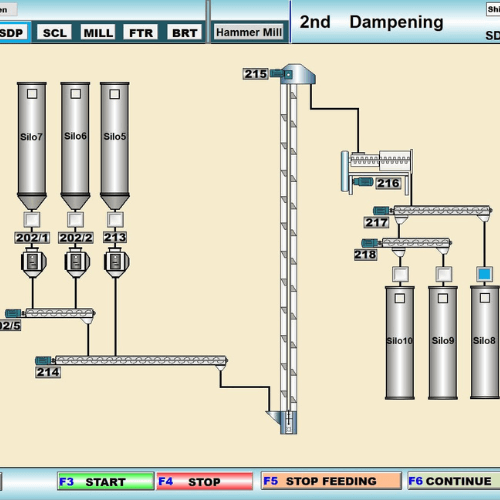
SCADA platforms display real-time data through graphical dashboards, diagrams, and trend charts that allow engineers and operators to understand the entire production process at a glance.
In addition to monitoring, SCADA systems can also provide remote control capabilities, alarm management, and historical data storage for performance analysis and system optimization.
Integration of PLC, HMI, and SCADA Systems
The true power of industrial automation emerges when PLC, HMI, and SCADA systems are integrated into a single control architecture.
In a typical automation structure, PLCs perform the direct control of machinery and execute the programmed operational logic. HMI systems provide local visual interfaces that allow operators to interact with the equipment easily.
Meanwhile, SCADA systems operate at the supervisory level by collecting data from PLC controllers, analyzing system performance, and providing centralized monitoring for the entire facility.
This integrated architecture provides complete visibility into production operations, allowing companies to optimize performance, detect problems early, and improve overall operational efficiency.
Benefits of Using PLC, HMI, and SCADA Systems
Implementing these technologies offers numerous advantages for modern industrial facilities. One of the most significant benefits is improved process control and operational stability.
Automation systems reduce the risk of human errors by executing production processes based on predefined logic and programmed instructions.
Real-time monitoring provided by SCADA systems allows operators to detect abnormalities quickly and take corrective action before they impact production.
These systems also provide valuable production data that can be analyzed to improve efficiency, optimize energy consumption, and enhance equipment maintenance strategies.
Overall, PLC, HMI, and SCADA technologies enable factories to achieve higher productivity while maintaining consistent product quality.
Industrial Applications
PLC, HMI, and SCADA systems are widely used across many industrial sectors due to their flexibility and reliability.
In the food industry, these systems control processing lines, packaging operations, and quality monitoring systems.
In flour mills and grain processing facilities, automation solutions help manage milling processes, monitor production flow, and maintain product consistency.
Chemical plants use these systems to monitor critical parameters such as pressure, temperature, and flow rates to ensure safe and stable operations.
Packaging factories also rely on automation systems to coordinate filling machines, conveyors, inspection systems, and labeling equipment.
The Future of Industrial Automation
As industries continue to move toward digital transformation, the concept of Smart Factories is becoming more common. These factories rely heavily on automation technologies to improve operational intelligence and efficiency.
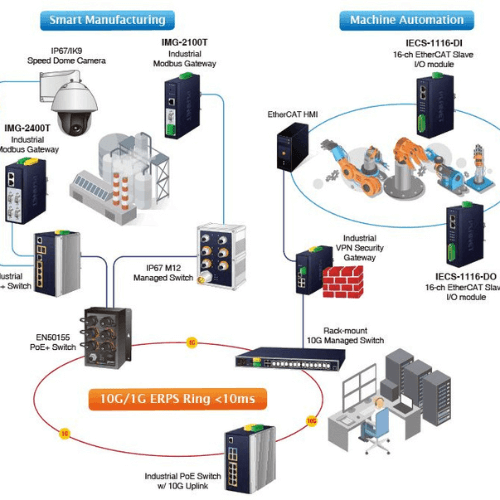
PLC, HMI, and SCADA systems form the foundation of these smart manufacturing environments by enabling real-time data collection, centralized monitoring, and intelligent decision-making.
With advancements in connectivity, data analytics, and industrial networking, automation systems will continue to evolve and play an even greater role in the future of manufacturing.
Conclusion
PLC, HMI, and SCADA systems represent the core architecture of modern industrial automation. Together, they provide precise machine control, real-time monitoring, and advanced data management capabilities.
By integrating these technologies, factories can achieve better process control, improved operational efficiency, and higher levels of production reliability.
As industrial automation continues to expand across various sectors, the importance of these systems will only continue to grow, supporting the development of smarter and more efficient manufacturing environments.