Introduction
Since the dawn of the industrial revolution, humanity’s goal has always been to increase productivity while reducing effort and cost. With the rapid pace of technological advancements, Industrial Automation has emerged as one of the most critical drivers reshaping the global economy.
Industrial automation is not merely about replacing humans with machines or robots. It represents a fully integrated system of devices, software, and intelligent control tools designed to execute industrial processes with maximum precision, efficiency, and quality.
In this article, we will explore the concept of industrial automation, its core components, key technologies, diverse applications, advantages, challenges, and its future prospects within the framework of the Fourth Industrial Revolution (Industry 4.0).
What is Industrial Automation?
Industrial automation refers to the use of various control systems—such as computers, Programmable Logic Controllers (PLCs), robots, and sensors—to operate machinery and industrial processes with minimal or no human intervention.
Simply put, automation allows machines to function according to preprogrammed instructions, completing tasks more efficiently and enabling humans to focus on strategic and creative roles.
Core Components of Industrial Automation Systems
Industrial automation relies on the integration of several essential components:
-
Sensors and Measurement Devices
-
Collect real-time data from the environment, such as temperature, pressure, flow, or vibration.
-
Examples: temperature sensors, flow meters, optical sensors.
-
-
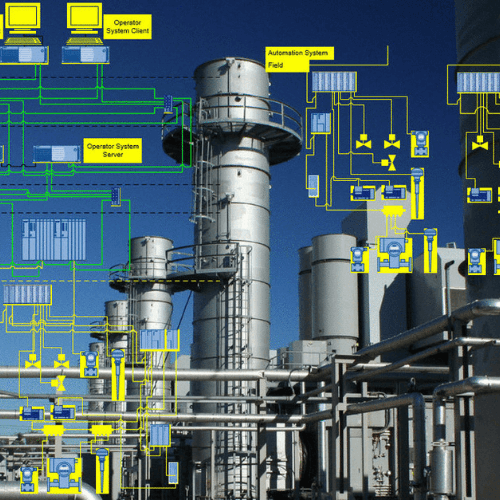
Control Devices (PLC and DCS)
-
PLC (Programmable Logic Controller): A compact computer designed to control industrial processes based on sensor input.
-
DCS (Distributed Control System): A large-scale system used in complex industries like refineries and power plants.
-
-
Actuators
-
Convert electrical or digital commands into physical action.
-
Examples: motors, valves, robotic arms.
-
-
Human-Machine Interfaces (HMI)
-
Provide graphical platforms for operators to monitor and control industrial processes.
-
-
Supervisory and Data Systems (SCADA)
-
Collect, visualize, and store real-time data for monitoring and analysis.
-
Key Technologies in Industrial Automation
Industrial automation integrates multiple advanced technologies:
-
Industrial Robots: Robotic arms performing tasks such as welding, assembly, painting, and packaging.
-
CNC (Computer Numerical Control): Automated precision in machining and manufacturing.
-
SCADA and HMI Systems: For real-time process monitoring and control.
-
Industrial Internet of Things (IIoT): Connecting sensors and devices across networks for data exchange.
-
Artificial Intelligence and Machine Learning: For predictive maintenance, process optimization, and advanced analytics.
-
Cloud and Edge Computing: Enhancing data processing speed, storage, and scalability.
Applications of Industrial Automation
Industrial automation plays a transformative role across multiple sectors:
-
Manufacturing
-
Automated assembly lines in automotive and electronics industries.
-
Real-time quality control and waste reduction.
-
-
Energy
-
Operation of power plants and smart grids.
-
Integration of renewable energy sources such as solar and wind.
-
-
Oil & Gas
-
Monitoring and controlling drilling, refining, and transportation.
-
Enhancing safety and minimizing operational risks.
-
-
Food & Beverage
-
Automating packaging, labeling, and quality assurance.
-
Ensuring compliance with health and safety standards.
-
-
Water and Wastewater Treatment
-
Managing treatment plants and distribution systems.
-
Optimizing efficiency and reducing water losses.
-
-
Logistics and Transportation
-
Automated sorting in airports and shipping hubs.
-
Warehouse robotics and smart logistics management.
-
Benefits of Industrial Automation
-
Increased Productivity: 24/7 operation without breaks.
-
Improved Quality: Reduced human error and enhanced precision.
-
Cost Reduction: Lower labor requirements for repetitive tasks.
-
Enhanced Safety: Minimizing human exposure to hazardous environments.
-
Flexibility: Quick reconfiguration of production lines to meet market demands.
-
Sustainability: Optimized resource and energy usage.
Challenges of Industrial Automation
Despite its advantages, automation faces several challenges:
-
High Initial Investment: Setting up infrastructure requires significant capital.
-
Job Displacement: Automation can replace certain human roles, creating workforce challenges.
-
Technical Complexity: Requires skilled engineers for system operation and maintenance.
-
Cybersecurity Risks: Connectivity exposes systems to potential cyberattacks.
-
Integration with Legacy Systems: Difficulties arise when merging automation with outdated equipment.
The Future of Industrial Automation in Industry 4.0
With the rise of Industry 4.0, the future of automation looks even more promising:
-
Smart Factories: Fully connected ecosystems leveraging data analytics and AI.
-
Collaborative Robots (Cobots): Robots designed to safely work alongside humans.
-
Advanced AI Solutions: Transforming predictive analytics and decision-making.
-
Digital Twin Technology: Virtual replicas of industrial processes for simulation and optimization.
-
Sustainable Integration: Supporting renewable energy adoption and eco-friendly manufacturing.
In the Gulf region and the Arab world, industrial automation is expanding rapidly, particularly with smart city initiatives, Saudi Vision 2030, and major investments in oil, gas, and renewable energy sectors.
Conclusion
Industrial automation is no longer a luxury—it is a necessity for organizations aiming to compete globally. By enhancing productivity, quality, and safety, automation is shaping the industries of tomorrow.
Although challenges such as costs, job transitions, and cybersecurity persist, the trajectory is clear: automation is the future. With the integration of IIoT, AI, and cloud technologies, industrial automation will continue to redefine the global industrial landscape for decades to come.