Introduction
The industrial sector is evolving rapidly, and manufacturers are increasingly looking for smarter, more reliable, and more connected solutions that can support modern production requirements. Today, the success of a factory is no longer measured only by the quality of its equipment or the size of its production capacity. It also depends on operational efficiency, process accuracy, production visibility, data availability, and the ability to make informed decisions at the right time.
As industrial automation, digital technologies, and specialized software continue to transform manufacturing, factories are gaining new opportunities to improve performance, reduce operational errors, increase product quality, optimize resources, and achieve greater production stability.
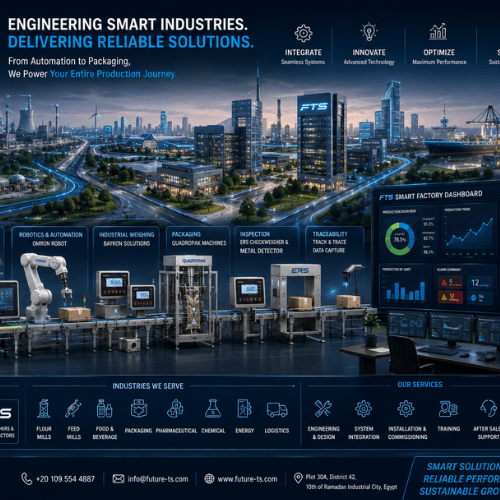
At Future Tech Solutions, we provide integrated industrial solutions designed to help factories develop their operations and improve production efficiency through three main divisions:
- Industrial Automation
- Industrial Software Solutions
- Packaging Systems
Our goal is to connect these areas into one integrated operational environment, starting with the control and automation of industrial equipment, continuing through data collection and software management, and extending to efficient and accurate product packaging.
Industrial Automation: Greater Control and Higher Production Efficiency
Industrial automation is one of the most important technologies supporting modern manufacturing. It helps reduce dependence on manual operations, improve process accuracy, increase production efficiency, and maintain stable and reliable performance.
At Future Tech Solutions, we design and implement industrial automation solutions based on the specific requirements of each factory. Every production environment has its own equipment, operating procedures, production targets, and technical challenges. Therefore, our solutions are developed to match the actual needs of the operation rather than applying a single standard approach.
Understanding the Production Process Before Implementation
Every successful automation project begins with a detailed understanding of the production process.
Before developing a solution, our team studies:
- Production sequences
- Equipment operating methods
- Manual intervention points
- Production bottlenecks
- Equipment downtime
- Existing control systems
- Process monitoring requirements
- Opportunities for operational improvement
This assessment allows us to develop practical automation solutions that improve performance while supporting the factory’s current and future requirements.
PLC Systems
Programmable Logic Controllers, commonly known as PLCs, are among the most important components of industrial automation.
PLCs receive signals from sensors, switches, measuring devices, and industrial equipment. They process this information according to programmed control logic and send commands to motors, valves, pumps, conveyors, and other production equipment.
PLC systems can be used for:
- Starting and stopping industrial equipment
- Motor control
- Conveyor management
- Batching and dosing processes
- Mixing operations
- Pump and valve control
- Production sequencing
- Automated material handling
- Alarm and fault monitoring
- Safety and emergency control
By implementing properly designed PLC solutions, manufacturers can achieve faster response times, improved process accuracy, reduced human error, and greater flexibility for future development.
HMI Systems
Human-Machine Interface, or HMI, systems provide operators with a clear and user-friendly way to monitor and control industrial processes.
An HMI can display:
- Equipment operating status
- Production information
- Process values
- Motor and machine conditions
- Alarm notifications
- Operating modes
- Start and stop controls
- Performance indicators
At Future Tech Solutions, HMI interfaces are designed according to the requirements of each process, helping operators access important information quickly and operate equipment more efficiently.
SCADA Systems
Supervisory Control and Data Acquisition, or SCADA, systems provide centralized monitoring, control, data collection, and visualization for industrial operations.
Through SCADA systems, factories can:
- Monitor production processes in real time
- View equipment status
- Track production performance
- Collect and store operational data
- Manage alarms and notifications
- Monitor equipment downtime
- Generate operational reports
- Analyze production performance
- Compare production results
SCADA systems provide a complete view of industrial operations, allowing operators and management teams to identify issues more quickly and make informed decisions based on accurate data.
Industrial Control Panels
Industrial control panels are an essential part of automation systems because they bring control components together in an organized and reliable structure.
At Future Tech Solutions, we design and assemble control panels according to project requirements while considering:
- Proper component organization
- Safe electrical connections
- Clear labeling and identification
- Easy maintenance
- System protection
- Operational reliability
- Future expansion requirements
Control panels may include PLCs, power supplies, protection devices, communication equipment, control components, and other industrial devices required for the system.
Automation System Integration
The value of industrial automation increases when different systems operate as one connected environment.
Automation systems can be integrated with:
- Industrial weighing systems
- Packaging equipment
- Conveyors and material-handling systems
- Inspection systems
- Production software
- Industrial databases
- Monitoring platforms
This integration reduces manual intervention, improves information flow, and supports more efficient production operations.
Industrial Software Solutions: Managing Factory Operations Through Data
Data has become one of the most valuable resources in modern manufacturing.
Every production process generates information that can help manufacturers understand performance and identify opportunities for improvement. Production quantities, material movement, equipment operating time, machine downtime, maintenance records, inventory transactions, and quality information can all provide valuable insights.
At Future Tech Solutions, we develop customized industrial software solutions that help factories organize, monitor, and manage their operations more effectively.
Software Designed Around Factory Requirements
Every factory has different workflows, production methods, departments, and management requirements. For this reason, a single software solution may not meet the needs of every operation.
Before developing a system, we study:
- Factory structure
- Operational departments
- Material movement
- Production cycles
- Workflows
- Management requirements
- Required reports
- Data collection needs
Based on this analysis, we develop software solutions that support the actual operational environment.
Production Management Systems
Production management systems provide visibility across different manufacturing stages and help organizations monitor production performance.
These systems can support:
- Production order management
- Production quantity tracking
- Production-stage monitoring
- Shift performance analysis
- Raw-material consumption
- Production rates
- Equipment downtime
- Production losses
- Production-line efficiency
By organizing production information, these systems help management teams improve planning and make better operational decisions.
Warehouse and Inventory Management
Effective inventory management is essential for maintaining production continuity and controlling operational costs.
Our software solutions can support:
- Material receiving
- Material issuing
- Inventory balance monitoring
- Raw-material management
- Finished-product management
- Warehouse movement tracking
- Stock reporting
- Material consumption analysis
These capabilities help factories maintain accurate inventory information and improve control over material movement.
Maintenance Management Systems
Unexpected equipment failures can lead to production delays, increased maintenance costs, and operational losses.
Maintenance software helps organize maintenance activities and improve equipment availability.
Key functions may include:
- Fault registration
- Maintenance request tracking
- Preventive maintenance scheduling
- Equipment condition monitoring
- Maintenance history
- Failure analysis
- Spare-parts tracking
By improving maintenance planning, factories can reduce unexpected downtime and support more reliable production.
Spare-Parts Management
Spare-parts availability is important for maintaining equipment readiness and reducing maintenance delays.
Spare-parts management systems can support:
- Spare-parts registration
- Inventory monitoring
- Receiving and issuing records
- Minimum stock levels
- Spare-parts usage tracking
- Consumption reports
These functions help maintenance teams maintain better control over critical spare parts.
Reports and Management Dashboards
Reports and dashboards provide a clear view of factory performance.
They can present information related to:
- Production
- Material consumption
- Equipment downtime
- Inventory
- Maintenance
- Machine performance
- Operational efficiency
Dashboards make important information easier to understand and help management teams monitor performance more effectively.
Industrial Web Applications
Web-based industrial applications provide flexible access to operational information through organized and user-friendly interfaces.
These applications can support:
- Production monitoring
- Report access
- Performance tracking
- Data management
- Department integration
They help provide faster access to important information while maintaining organized and structured data.
Packaging Systems: Greater Accuracy, Higher Speed, and Better Production Performance
Packaging is one of the most important stages of manufacturing because it directly affects product quality, filling accuracy, production speed, operational efficiency, and the final presentation of the product.
At Future Tech Solutions, we provide integrated packaging solutions designed according to product characteristics and production requirements.
Understanding Packaging Requirements
Before selecting a packaging system, we study:
- Product type
- Product characteristics
- Powder or granular properties
- Required packaging weights
- Packaging material
- Production capacity
- Available installation space
- Required automation level
This evaluation helps ensure that the selected solution matches the product and production environment.
Automatic Packaging Systems
Automatic packaging systems help manufacturers:
- Increase production speed
- Improve filling accuracy
- Reduce manual intervention
- Minimize operational errors
- Improve production consistency
- Increase overall efficiency
These systems provide stable and reliable operation, especially in production environments with high output requirements.
Packaging Powder and Granular Products
Different products require different feeding, weighing, and packaging methods.
We provide packaging solutions for:
- Powder products
- Granular products
- Agricultural products
- Food products
- Feed products
- Industrial materials
Each solution is selected and configured according to the characteristics of the product and the required production capacity.
Integration with Industrial Weighing Systems
Industrial weighing technologies play an important role in achieving accurate and consistent packaging.
Packaging systems can be integrated with:
- Load cells
- Weight indicators
- Weight transmitters
- PLC systems
- Production monitoring platforms
This integration helps control product quantities, reduce material waste, and improve packaging quality.
Integration with Production Lines
Packaging systems can be connected with other stages of the production process, including:
- Product feeding systems
- Conveyor systems
- Industrial weighing equipment
- Inspection systems
- Automation platforms
- Industrial software
This creates an integrated production line where different systems communicate and operate efficiently.
Industries We Serve
Future Tech Solutions provides industrial solutions for a wide range of sectors, including:
- Flour mills
- Food manufacturing
- Feed factories
- Detergent manufacturing
- Chemical industries
- Agricultural industries
- Packaging facilities
- Various industrial production lines
Each solution is developed according to the operational requirements and production objectives of the industry.
Why Choose Future Tech Solutions?
At Future Tech Solutions, we do not focus only on supplying equipment or developing individual software systems. We work to create connected solutions that support long-term operational improvement.
Our strengths include:
- Integrated industrial solutions
- Detailed customer requirement analysis
- Specialized engineering and technical expertise
- Customized systems
- Integration between automation, software, and packaging
- Installation and commissioning
- Operator training
- Technical support
- After-sales services
- Scalable solutions for future development
The Future of Manufacturing Begins with Integrated Solutions
Manufacturing is moving toward smart and connected factories where automation systems, software platforms, production equipment, and operational data work together.
When industrial automation is integrated with software and packaging systems, factories gain greater visibility and improved control over production.
Integrated solutions help manufacturers:
- Increase productivity
- Improve product quality
- Reduce operational errors
- Minimize material waste
- Optimize resource utilization
- Improve production efficiency
- Access accurate operational data
- Support continuous improvement
Conclusion
Future Tech Solutions provides integrated industrial solutions that combine Industrial Automation, Industrial Software Solutions, and Packaging Systems to help manufacturers improve operational performance and achieve greater accuracy, efficiency, and reliability.
By understanding the requirements of each customer and developing solutions based on the actual production environment, we help create smarter and more connected manufacturing operations that can meet the demands of modern industry.
Future Tech Solutions — Your Partner for Industrial Development, Improved Production Efficiency, and a Smarter Manufacturing Future.